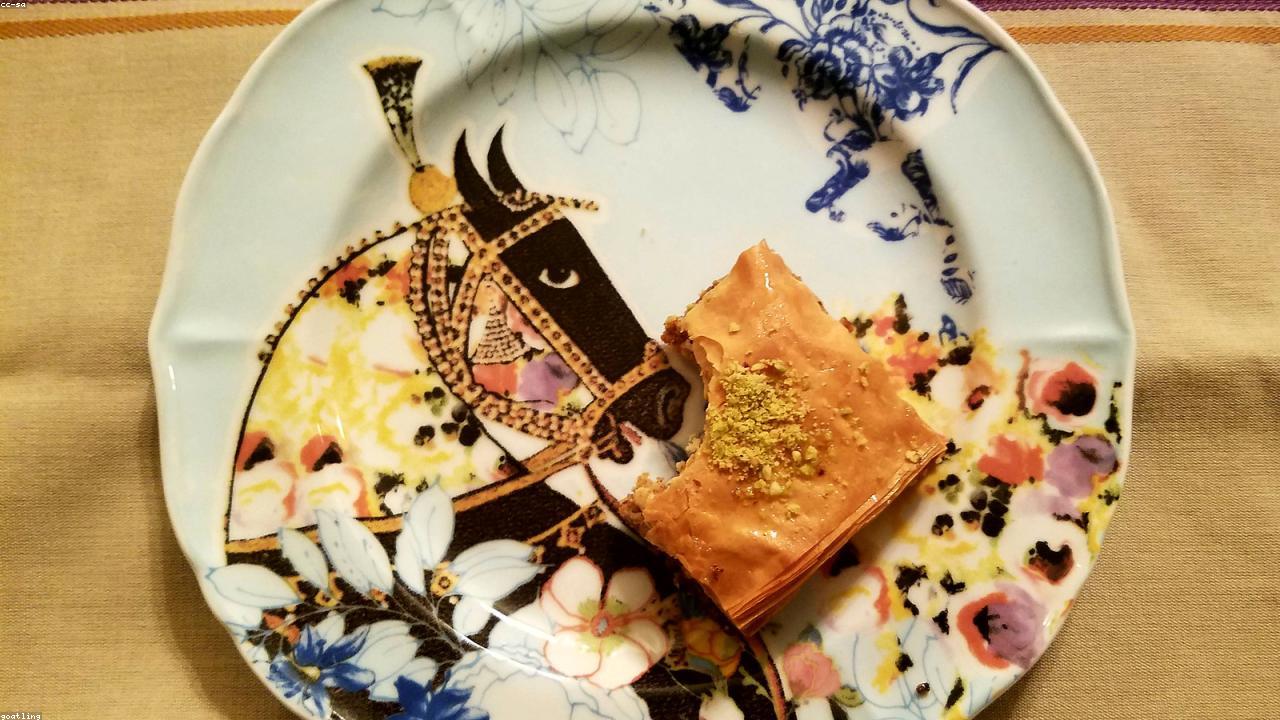
Baklava is a study in layers. Dozens of sheets of phyllo, each brushed with butter and stacked tissue-thin, sandwich a bed of chopped nuts. Baked until deep gold and crackling, the whole tray is then drenched in a fragrant syrup of honey or sugar perfumed with lemon and spice. The result is rich, sticky, intensely sweet, and shatteringly crisp all at once.
It is also one of the most fiercely and lovingly claimed sweets on earth — a dish whose heritage stretches across the Eastern Mediterranean and the Middle East, and which we will treat with the respect that shared history deserves.
Built on phyllo: the foundation
Baklava is, before anything else, a phyllo pastry. Phyllo (from the Greek for "leaf") is dough rolled or stretched until it is almost transparent — so thin you can read print through it. Unlike laminated doughs such as puff pastry, phyllo gets its layers not from folding butter into the dough, but from stacking many separate sheets and brushing each one with fat.
In baklava that fat is usually melted butter (clarified butter or ghee in many traditions). As the tray bakes, the butter between the leaves crisps each sheet individually, so the finished pastry is a tower of dozens of distinct, brittle layers rather than one solid mass. Getting that crisp, even bake — and keeping the fragile sheets from drying out and tearing during assembly — is the real craft of the pastry.
Nuts, butter and the build
The construction follows a clear logic, repeated patiently:
- A base of buttered sheets. Several layers of phyllo are laid in a tray, each brushed with butter, to form a sturdy crisp bottom.
- A nut layer. Chopped nuts — most often walnuts or pistachios, sometimes almonds — mixed with sugar and warm spices like cinnamon or clove are scattered across.
- More buttered phyllo, more nuts. The pattern repeats, building height; some traditions favour many thin nut layers, others a few thick ones.
- A buttered top. A final stack of sheets crowns the tray.
The choice of nut is itself regional and meaningful: pistachio-forward baklava is associated with cities like Gaziantep, while walnut versions dominate elsewhere — a small map of taste baked into the tray.
Why it is cut before baking
Here is a step that surprises newcomers: baklava is cut before it goes into the oven, not after. The assembled tray is sliced through with a sharp knife into its serving shapes — the classic diamonds (lozenges) or triangles, sometimes squares or rolled cylinders.
There is a practical reason. Baked phyllo is so brittle that trying to cut it afterwards would shatter the layers into a crumbled mess. By cutting first, the baker creates clean channels; later, those same channels let the syrup run down into every layer and pool around each piece, so the sweetness reaches all the way through rather than sitting on top.
The syrup and the hot-or-cold debate
The soak transforms baklava from a dry, nutty pastry into the glistening sweet we know. The syrup is built from sugar and/or honey and water, boiled to the right consistency and perfumed with lemon juice (which keeps it from crystallising and cuts the sweetness), and often rose water, orange-blossom water, cinnamon or cloves.
And then comes the great kitchen argument: do you pour hot syrup over hot baklava, or contrast the temperatures? The near-universal rule among experienced bakers is to keep a temperature difference — most commonly cool or room-temperature syrup poured over hot baklava straight from the oven (or, conversely, hot syrup over a cooled tray). If both are hot, the pastry tends to go soft and soggy; the temperature gap lets the phyllo drink in the syrup while staying crisp. Exactly which way round is a matter of household and regional tradition, and cooks defend their method with real conviction. After soaking, baklava is rested for hours, even overnight, so the syrup settles evenly.
A contested, shared heritage
Few sweets are claimed by as many peoples as baklava, and it would be wrong to hand it to a single nation. Its modern form is closely tied to the Ottoman Empire — the imperial kitchens of Istanbul's Topkapı Palace are central to its development and refinement — but versions and ancestors are woven through Greek, Turkish, Armenian, Levantine, Persian and wider Middle Eastern cooking, each with its own nuts, spices, syrups and stories.
Older threads reach back to layered, nut-filled breads and sweets of the ancient and medieval worlds, and the dish as we know it is a confluence of many hands across centuries and empires. So rather than crown an inventor, the honest and respectful view is this: baklava is a shared heritage of the Eastern Mediterranean and the Middle East, beloved across borders that have shifted many times around it. That it is claimed so passionately by so many is itself a measure of how good, and how deeply rooted, it is.
Frequently asked questions
Where does baklava come from?add
Its heritage is genuinely shared and contested. The modern form is strongly associated with the Ottoman Empire and the kitchens of Istanbul, but Greek, Turkish, Armenian, Levantine, Persian and other Middle Eastern cultures all have deep-rooted traditions of it. It is most fairly described as a shared sweet of the Eastern Mediterranean and Middle East rather than the invention of one nation.
Should syrup be poured hot or cold over baklava?add
The key is a temperature contrast. Most bakers pour cool or room-temperature syrup over hot baklava (or hot syrup over a cooled tray). If both are hot the pastry turns soggy; the temperature gap lets the crisp phyllo absorb the syrup while staying crunchy. Which direction you use is a matter of tradition.
Why is baklava cut before baking?add
Because baked phyllo is far too brittle to cut cleanly — it would shatter. Cutting the assembled tray into diamonds or triangles before baking creates neat pieces and channels that let the syrup soak down into every layer after it comes out of the oven.
What nuts are used in baklava?add
Most commonly walnuts or pistachios, and sometimes almonds, mixed with sugar and warm spices. The choice is regional: pistachio-heavy baklava is associated with cities like Gaziantep, while walnut versions are traditional in many other areas.