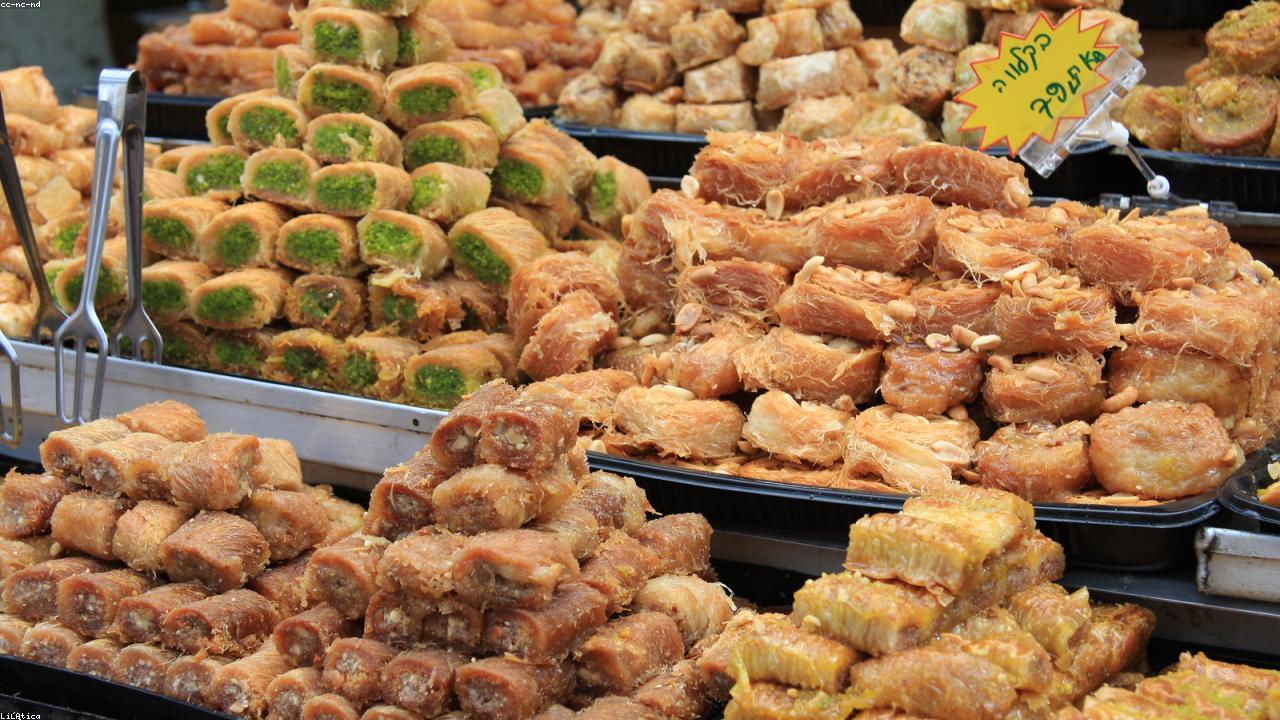
If French pastry is the grammar of butter and lamination, Greek pastries are the grammar of phyllo — sheets of dough stretched until you can read a newspaper through them, then layered, brushed with butter or oil, and either filled with nuts and drenched in syrup or wrapped around savoury greens and cheese.
This single dough runs through nearly the whole Greek repertoire, sweet and savoury alike. Around it sits a culture of honey, semolina, citrus and slow afternoons — pastries built less for the patisserie window than for the family table and the corner zacharoplasteio.
Phyllo: the dough at the heart of it all
The defining technique of Greek baking is phyllo (from the Greek fyllo, "leaf") — unleavened dough rolled and stretched into sheets so thin they are nearly translucent. Where French lamination traps butter inside the dough by folding, phyllo builds its flakiness between stacked sheets, each one painted with melted butter or olive oil before the next is laid on top.
The reward is a pastry that bakes into dozens of brittle, shattering layers. The skill lies in the stretching: traditional bakers pull a single ball of dough across a floured table until it drapes off the edges like a sheet, almost see-through. It is the same dough across the eastern Mediterranean, and in Greece it is the foundation of both the dessert tray and the savoury pie.
Signature pastry: baklava
No pastry carries the Greek phyllo tradition further than baklava — and it earns its own deep dive.
- Baklava — dozens of buttered phyllo sheets layered with a thick seam of crushed walnuts (and often pistachios or almonds), cut into diamonds, baked until deep gold, then flooded with a hot honey-and-lemon syrup that seeps into every layer. Read the full story of how it is built, syruped and cut.
The sweet phyllo family
Baklava is the headline, but the syrup-soaked phyllo tray runs much deeper:
- Galaktoboureko — a semolina custard baked between phyllo and bathed in syrup; rich, creamy and quietly the favourite of many Greeks over baklava.
- Bougatsa — a breakfast pastry from Thessaloniki, phyllo wrapped around either sweet semolina custard (dusted with sugar and cinnamon) or a savoury cheese filling.
- Kataifi — made not with sheets but with shredded phyllo that looks like fine golden hair, wrapped around nuts and syruped like baklava.
Beyond phyllo, Greek sweets reach for loukoumades — small yeast-risen doughnuts fried crisp, then dipped in honey syrup and scattered with cinnamon and walnuts, often called the dessert of the gods and among the oldest recorded sweets in Europe.
Savoury phyllo: spanakopita and the village pita
The same phyllo that holds honey and nuts also holds greens and cheese. The most famous is spanakopita, the spinach and feta pastry: spinach (and wild greens, dill and spring onion) bound with crumbled feta, sealed between buttered phyllo and baked into a golden pie cut in squares or rolled into individual coils.
It is one of a wider family of pita (savoury pies): tyropita filled with cheese alone, kreatopita with meat, kotopita with chicken and hortopita with foraged greens. In village kitchens these pies are the everyday workhorse of the phyllo tradition — proof that the dough is as much about lunch as it is about dessert.
Honey, nuts and semolina
Three ingredients give Greek sweets their character. Honey — thyme honey from the islands above all — is the original sweetener and syrup base, predating refined sugar by millennia; ancient Greeks were already making honey-and-nut pastries that read as baklava's ancestors. Nuts, chiefly walnuts but also almonds and pistachios, provide the substance packed between phyllo layers.
And semolina — coarse durum wheat — is the quiet backbone of the custard sweets, thickening the fillings of galaktoboureko and bougatsa and forming the base of halva. Tie them together with cinnamon, clove and a squeeze of lemon, and you have the flavour signature of the Greek dessert tray.
Frequently asked questions
What is the most famous Greek pastry?add
Baklava is the most internationally recognised Greek pastry — layers of buttered phyllo and crushed nuts soaked in honey syrup. Within Greece, many people are equally devoted to galaktoboureko, a syrup-soaked semolina custard baked in phyllo. Both sit at the heart of the country's phyllo tradition.
What is the spinach and feta pastry called?add
It is called spanakopita — a savoury Greek pie of spinach and herbs bound with feta cheese and baked between buttered sheets of phyllo. It can be made as a large tray pie cut into squares or as individual triangles and coils, and it shows how the same phyllo dough is used for savoury bakes as well as sweets.
What is phyllo and how is it different from puff pastry?add
Phyllo is an unleavened dough stretched into tissue-thin sheets that are stacked and brushed with butter or oil to create layers. Puff pastry, by contrast, traps butter inside folded dough through lamination. Phyllo is drier and shatters into brittle leaves, while puff pastry rises into buttery, airy flakes. See our phyllo pastry guide for more.
What are loukoumades?add
Loukoumades are small, light Greek doughnuts made from a yeasted batter, deep-fried until golden and crisp, then drenched in honey syrup and sprinkled with cinnamon and crushed walnuts. Often described as one of the oldest desserts in Europe, they are a street-food and festival favourite.