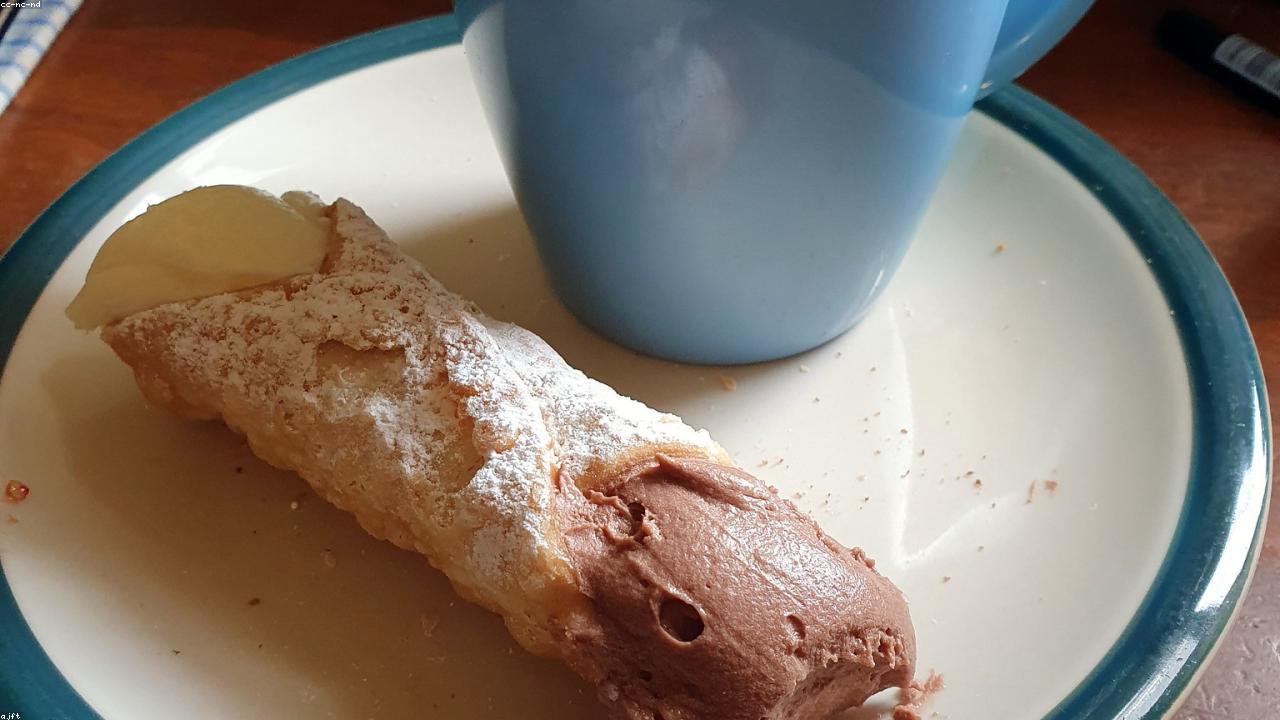
The cannolo is the great sweet of Sicily: a crisp, blistered tube of fried pastry — the scorza, or "bark" — packed with cool, sweet ricotta and finished at the open ends with chocolate, candied fruit or pistachio. The contrast is everything: a shell that shatters against a filling so smooth it barely needs chewing.
A quick note before anything else, because Italians care about it: one is a cannolo; two or more are cannoli. "A cannoli" makes a Sicilian wince. With that settled, the pastry rewards a closer look, because almost everything about it is engineered to defend that crucial crispness.
Sicilian origins and Arab-Norman roots
The cannolo is Sicilian to its core, and its history is bound up with the island's layered past. Sicily passed through Arab and then Norman rule in the early Middle Ages, and that Arab-Norman period left a deep mark on its sweets — the love of ricotta, candied fruit, sugar, almonds and citrus that defines Sicilian pastry owes much to it.
The town of Caltanissetta in central Sicily is the origin most frequently cited, with a long-repeated tradition linking the pastry to the area's convents, where nuns are said to have made cannoli, particularly around Carnival. As with many old foods the precise birth story is more legend than documented fact, and we present it as such — but the Sicilian, and specifically central-Sicilian, heartland of the cannolo is not seriously in doubt.
The shell: wine, vinegar and the art of the blister
The scorza is a precise piece of engineering. The dough is enriched and acidulated with a splash of wine — often Marsala — and a little vinegar, then rolled very thin, wrapped around a metal tube and deep-fried.
That acidity and the wine do real work. They relax the gluten and, in the hot oil, encourage the surface to bubble and blister into the cannolo's characteristic pocked, uneven texture rather than frying smooth. Those blisters are not a flaw; they are the sign of a properly made shell, giving it the brittle, glassy crunch that is the whole point. A pinch of cocoa or cinnamon often tints and flavours the dough. Fried hard and golden, the shells are then slipped off their tubes and cooled — and, importantly, can be made ahead and kept crisp, empty, for days.
The ricotta filling
The classic filling is simply sweetened ricotta, and the best is made with sheep's-milk ricotta, which is richer, tangier and more fragrant than the cow's-milk kind. The ricotta is drained well to remove excess whey, then beaten smooth with sugar until silky — sometimes passed through a sieve for an especially fine texture.
From that base the variations bloom:
- Candied fruit — bits of candied orange or citron folded through or pressed onto the ends.
- Chocolate — chips stirred into the ricotta, or the open ends dipped in chopped dark chocolate.
- Pistachio — especially the prized green pistachios of Bronte, crushed over the ends.
A final dusting of powdered sugar and the cannolo is complete.
Why it must be filled to order
This is the single most important rule of the cannolo, and it follows directly from how it is built. The shell is crisp because it is dry; the filling is delicious because it is moist. Put them together and physics takes over: the moisture from the ricotta steadily migrates into the porous fried shell, turning that glassy crunch soft and soggy within hours.
So a serious Sicilian bakery fills cannoli to order — piping the ricotta into the empty shells only when you buy them, never in advance. A tray of pre-filled cannoli sitting in a display case is a quiet warning sign. The empty shells and the ricotta are kept apart and married at the last possible moment, which is exactly why a freshly filled cannolo is one of the great textural pleasures in all of pastry.
Cannoli in the wider pastry world
The cannolo belongs to a broad family of pastries built on a fried or baked shell and a sweet, fresh filling — and it shares its central tension, crisp-versus-creamy, with sweets right across the Mediterranean.
Its love of nuts, honey, candied fruit and pastry sits comfortably alongside the Arab-influenced sweets of the region, from the nut-and-syrup world of baklava to the citrus-bright dolci of the rest of Italy. And like every great pastry it rests on a handful of fundamentals — frying, sweetening dairy, balancing texture — executed with care. Master those, respect the fill-to-order rule, and the humble tube becomes the pride of an island.
Frequently asked questions
Is it cannoli or cannolo?add
"Cannolo" is the singular and "cannoli" the plural, from Italian. So you order one cannolo or a box of cannoli. Saying "a cannoli" is grammatically a mismatch, and in Sicily it is a small but noticeable giveaway.
Why is wine and vinegar in the cannoli shell?add
The wine (often Marsala) and a touch of vinegar add flavour and acidity that relaxes the gluten and helps the shell blister and bubble when fried, giving it that characteristic pocked surface and brittle, glassy crunch rather than a smooth, tough shell.
Why should cannoli be filled just before eating?add
Because the crisp shell is dry and the ricotta filling is moist. Once filled, moisture seeps from the filling into the porous shell and softens it within hours. Filling to order keeps the shell shatteringly crisp, which is the whole appeal of a good cannolo.
What is the best ricotta for cannoli?add
Well-drained sheep's-milk ricotta is the traditional and most prized choice, as it is richer and more fragrant than cow's-milk ricotta. Whichever you use, drain it thoroughly and beat it smooth with sugar so the filling is silky rather than grainy or watery.